Why Your Wrist Pain Isn't a Wrist Problem
Jul 14, 2026
I once met a teenager in Austria who couldn't hold a pen without wincing. She'd already seen multiple doctors and specialists, and there was even talk of screening her for bone cancer since nothing else explained the pain. I took one look at her and saw the problem wasn't in her wrist at all. It was in her shoulders and ribcage. I'll come back to her story in full further down, because it's a clear example of a theme that runs through everything I teach: stop looking where it hurts, and go find the actual source.
Most people dealing with chronic wrist or elbow pain have already been through a few specialists by the time they find me. But what almost no specialist is trained to do is zoom out and ask why a perfectly healthy wrist is suddenly under this much strain in the first place. So they stretch it, brace it, rest it, inject it, sometimes operate on it, and when that doesn't work, they assume something is seriously wrong. Usually, something very different is going on.
Quick Fix Case Studies: "I'm So Surprised My Wrist Pain Was Gone in a Single Session!"
Most cases are quick fixes.
I can think of several people who came to me barely able to work through the pain: desk workers, baristas, other people who rely on their hands all day. And more than one of them said almost exactly this after their very first visit: "I'm so surprised my wrist pain was gone in a single session!"
Not from resting. Not from bracing. But from targeted self-myofascial release, using a small ball to apply gentle, targeted pressure into the tight muscles leading to the wrist, often as far as the neck or rib cage. Combined with repositioning the wrist and elbow and easing unnecessary grip tension, that's usually enough to change things fast. When the fix is this direct, you can often do it yourself, which is exactly what I'm demonstrating in the video below.
This may give you immediate relief, but for lasting results, the work still expands beyond the forearm, because your arm is part of a much larger fascial network, a continuous chain of connective tissue running through your muscles from your fingers up into your shoulder and chest. That's exactly what the next section is about.
Why Wrist Pain Keeps Coming Back
Your wrist is not an isolated structure. It's part of a continuous system of connective tissue called fascia, which wraps and connects your muscles, joints, and nerves the way the pith under an orange peel connects everything inside. If you haven't read my breakdown of what that actually means, start here: Explaining Fascia, Myofascia, and Myofascial Release.
One of the most useful ways I've found to visualize this is through the Anatomy Trains model, which I studied directly with Tom Myers, the anatomist who developed it. It maps fascial pathways, sometimes called fascial chains, running from your fingers all the way to your spine and ribcage. Researchers have since confirmed real anatomical continuity along these same pathways, direct fascial connections tracing from the neck and shoulder all the way through the forearm.
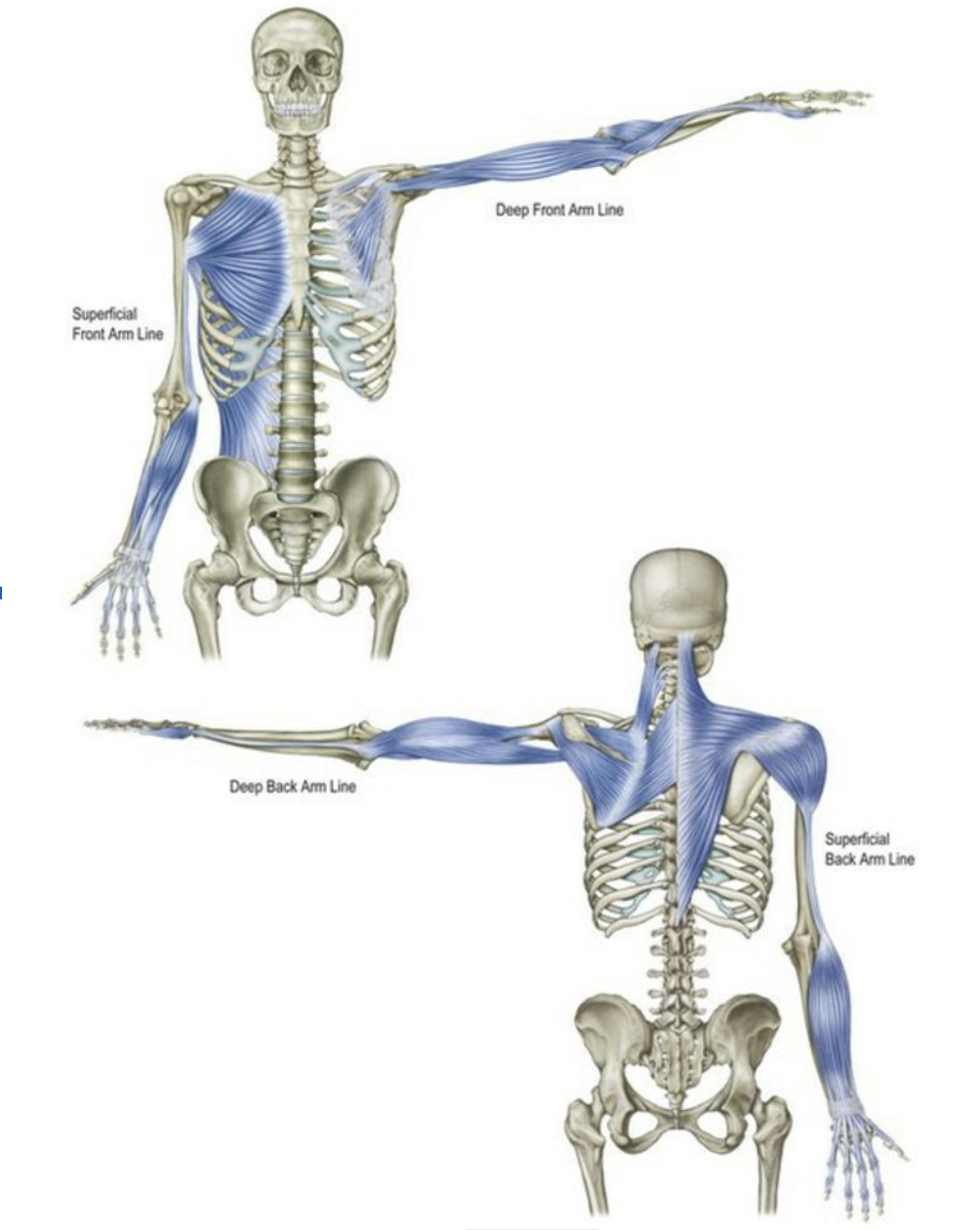
These lines connect your fingers to your forearm, your shoulder, your chest, and even into your torso. So when something is off upstream, your wrist often pays the price.
Your nerves run right alongside and through these same lines. When the tissue around a nerve stays tight long enough, the nerve itself can get stuck, compressed and irritated where it passes through, which is often what turns into the tingling, numbness, or pain that seems to come from nowhere.
The Method That Keeps Pain Away
1. Release tightness
Using tools like the Tune Up Fitness balls, we reduce excessive tension in the fascia so muscles, nerves, and fluid can all move freely again. This often brings immediate relief and increased range of motion, and it fast tracks targeted stretching and body mechanic awareness, as I teach in my Neck and Shoulder Pain Relief Course.
2. Realign the bones
Once we release tight, knotted muscles, we can actually see where a joint has drifted out of its correct position, and guide it back to where you feel less pain.
This is where interoception comes in. You learn to feel:
- When pain decreases, you're moving in the right direction
- When pain increases, something is off
Your body becomes the guide.
3. Strengthen into correct alignment
Now we reinforce the new pattern, not by overworking the same compensations, but by activating the right muscles in the way that locks in healthy alignment. My Neck and Shoulder Pain Relief Course teaches you how to do that as well.
A Critical Piece Most People Miss: Interoception
Most people are disconnected from the signals their body is giving them. They override pain. They push through tension. They guess.
Interoception changes that. It's the ability to sense what's happening inside your body in real time, and it's how my clients learn to:
- Find optimal joint positioning
- Adjust movement on the fly
- Stop problems before they become chronic
This is why the results last.
When It's More Than a Quick Fix
Some cases aren't a one-session story. They're months of work, because the pattern took years to build or an injury changed how the whole body moves. Here are two, one from an accident and one from a slow, systemic misalignment nobody had caught.
CASE STUDY: "From Out of the Art World to Exhibiting Again"
An artist came to me after multiple injuries from an accident had pushed her out of the art scene entirely. This wasn't only a wrist issue. It was a full-body pattern in how she was moving, loading, and recovering that caused tension that had spread from her shoulders and upper back all the way down through both arms. We worked through releasing that chronic tension, realigning the joints her tight muscles had pulled out of place, and rebuilding strength into right alignment, in that order.
As her system changed, her wrist stopped being the problem. Because it was never the problem.
She's back to exhibiting and selling her work again.
From “Too Painful to Write,” to Boxing
This is the teenager from Austria I mentioned at the start. Her shoulders had been riding forward on her ribcage for so long that her front arm line, the fascial chain (a continuous line of connective tissue) running from her chest through the inner arm to her hand, had shortened and stayed tight. That's what was pulling her wrist into a position where every pen stroke hurt. It built slowly, which is exactly why no specialist caught it.
I applied targeted pressure to release tight connective tissue to reduce that tension pattern enough that I could guide her shoulder blade and humerus (upper arm bone) back into a position where her bones could actually stack without causing muscle and nerve strain.
From there, we continued working together over Zoom for months. She got a set of Tune Up Fitness balls, a mat, blocks, and a strap , and learned to care for her entire body, not just the wrist. She learned her body mechanics, lengthened and strengthened the correct muscles, and now knows how to treat any new symptoms at the source instead of chasing where the pain showed up.
Today she's living in New York City, attending a prestigious art school. She recently came by to get the green light to start boxing. The text her mother sent says everything: "She frequently says you saved her life and her career. She was so worried she wouldn't be able to have a future in the arts. And look at her now!"
Cases like these two are exactly when I work with people 1:1 rather than just handing out a stretch routine. Untangling a pattern that took years to build, or that an accident rewired overnight, takes informed assessment and time. If what you're dealing with sounds more like this than a quick fix, that sustained, 1:1 work is exactly what I do with clients.
One More Thing: Not All Pain Is Good Pain
If you're going to work on your body, you need to understand the difference. I break that down here: Constructive Versus Destructive Pain.
The Takeaway
If you're treating your wrist in isolation, you're missing the bigger picture. The goal isn't to force the pain away. It's to understand why your body created it in the first place, and whether what you're dealing with is a quick fix or a pattern that needs real, sustained attention. That's when things actually change.
Not sure which one you are? That's exactly what my self-assessment quiz is built to help you find, the actual source of your pain, not just where you feel it.
Related Articles
Explaining Fascia, Myofascia, and Myofascial Release
Constructive Versus Destructive Pain
Case Study: The Shoulder Hip Connection
She came with shoulder pain. She left free of diverticulitis.
The Power of Bodywork for Treating Scoliosis
He Came to Me for Neck Pain, He Left Free of His Addictions
A Story of Learning to Listen to the Body
A Sequence to Make Your Recovery Faster and Easier
Build a Strong Core for Better Shoulder Health
Author