Why Mindset Comes First in Healing (and How It Changed Everything for Me)
Jan 23, 2026
There was a moment in my healing journey when something fundamentally shifted.
It wasn't a new supplement. It wasn't a new protocol. It wasn't even a new diagnosis.
It was the moment I stopped seeing my body as broken and started believing, deeply and sincerely, that I am a brilliant, self-healing organism.
Not in a motivational-poster way. Not as a hope. As a felt truth.
And once that belief landed, everything about my healing changed.
The Long Road to That Moment
I had been navigating chronic Lyme disease and a thyroid disorder for years. If you've been in that world, you know what it looks like: researching constantly, following the latest protocols, finding the specialists, getting the tests. All of it necessary. All of it exhausting. And at the heart of it, a quiet belief that my body was the problem to be solved.
I kept looking outside myself for the answer.
The shift happened when I finally asked a different question: what if the problem isn't that my body isn't working, but that I wasn't listening well enough?
That one question changed everything. It changed how I paid attention. It changed how I interpreted symptoms. It changed how I made decisions. And eventually, it led me to become a National Board-Certified Health and Wellness Coach, a certified HeartMath Professional, and to build the C. Twain Method around the principle that healing starts from the inside out.
Why Belief Led Me to Tracking
Once I trusted that my body is intelligent and constantly communicating, tracking became a natural next step. Not to override my body. To understand it.
Tracking taught me something critical: my body had been sending signals all along. I simply didn't yet have the language to interpret them. Patterns emerged. Triggers became visible. Cause and effect stopped being mysterious.
Tracking wasn't about control. It was about relationship.
And that relationship only worked because mindset came first. If I had still believed my body was unreliable or adversarial, tracking would have become anxious and rigid, another way to police myself. Because I trusted my body's wisdom, tracking became collaborative. I discovered things I never could have guessed from advice alone: that raw kale was making me feel terrible, that certain supplements genuinely helped, that my energy and recovery followed patterns I could learn to work with.
What Science Says About Mindset and Healing
This isn't just philosophy. The research is catching up to what many of us have already discovered in our bodies.
A finding highlighted by the Harvard Gazette showed that people healed faster when their perception of their own recovery time shifted. Their bodies responded differently based on how they understood their healing process. Same bodies. Different belief. Different outcome.
And it goes deeper than perception. Studies spanning three decades show that a negative pain mindset, one characterized by helplessness, catastrophizing, and the belief that nothing will change, predicts greater pain intensity, longer recovery, and higher medication use. The reverse is also true. What you believe about your body shapes what your nervous system does with every signal it receives.
The stress response is particularly important here. Hormones like cortisol and adrenaline don't just affect mood. A 2021 review in Frontiers in Bioscience found that chronic stress directly alters the cells inside fascia, the connective tissue web that runs through your entire body, making it stiffer and less responsive over time. Chronic alarm, whether it comes from a real threat or from a belief that you'll never heal, creates real physical consequences in your tissues.
Where HeartMath Comes In
My training as a certified HeartMath Professional gave me something I had been looking for without knowing it: a way to measure the mind-body connection in real time.
The tool is heart rate variability , or HRV. HRV is the variation in time between your heartbeats, and it turns out to be one of the most sensitive indicators of your nervous system's state. When you reach a state of coherence, your heart rhythm becomes smooth and ordered. Your brain and heart synchronize. Research from the HeartMath Institute shows that this state supports clearer thinking, emotional resilience, and a more regulated nervous system.
What shifts you into coherence? Not willpower. Not positive thinking. The quality of what you're genuinely feeling. A 2025 paper by Elbers and McCraty confirmed that coherence training measurably improves both emotional regulation and physiological resilience. And a global study in Scientific Reports analyzing 1.8 million HRV sessions found that positive emotional states consistently produced higher coherence, while negative states produced lower, more erratic readings.
I use HeartMath with clients because it makes the invisible visible. You can watch your own nervous system settle in real time. For people who have spent years fighting their bodies, that feedback changes something fundamental in the relationship.
This Is Why Mindset Is the First Pillar
The brain is the gateway through which every other intervention must pass.
If you believe you're broken, every symptom becomes a threat. If you don't trust your body, you'll misinterpret its signals. If you don't feel safe, regulation is harder. The other tools, breathwork, movement, rest, tracking, all of them work better when the nervous system isn't running on alarm.
This is not about toxic positivity. It's not about ignoring symptoms or pretending everything is fine. It's about approaching your body with curiosity instead of judgment. "What is my body trying to tell me?" is a fundamentally different question than "Why is my body broken?" It activates a different part of your brain and creates a different neurochemical environment. And your body responds accordingly.
Where to Start
If this resonates, the first step is simpler than you might expect: just start listening.
Pay attention to the stories you tell about your body. Not to judge them, but to notice them. "I've always been like this." "I just need to push through." "Other people have it worse." These beliefs are running quietly in the background, shaping how your nervous system interprets every sensation.
The next step is tracking. Not as a way to control or police yourself, but as a way to learn your body's language. When you approach it that way, patterns emerge that no specialist can find for you, because they're yours alone.
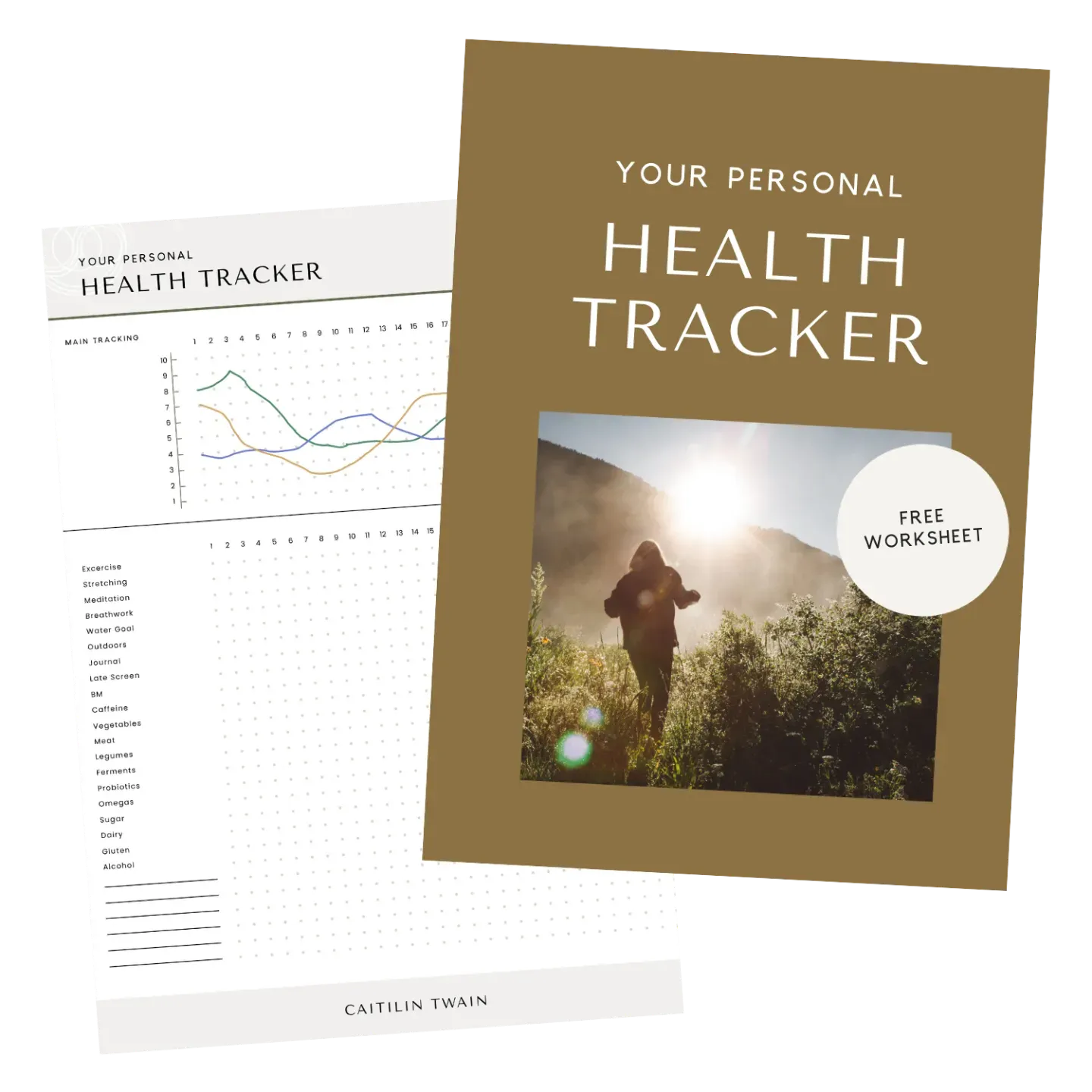
I created a free tracker to help you begin that conversation. No rules, no pressure. Just a framework for noticing what's actually happening in your body, and starting to connect the dots.
If you want to take this further with real structure and support, my Concierge program is built for exactly this work. Over six months, we build a protocol entirely around you — your medical history, your biometric data, your body, your life — and work with the full suite of tools in the C. Twain Method: breathwork, HeartMath biofeedback, self-myofascial release, movement, and health coaching. Your data is reviewed daily. As patterns emerge, you learn to read them alongside me. I also coordinate directly with your medical team so that what we discover informs the care you're already receiving. Several clients have reduced or eliminated medications over the course of the program — not by walking away from medical care, but by finally giving their bodies what those medications were compensating for. If you've spent years managing symptoms and are ready to understand what your body has actually been trying to tell you, this is where that work happens.
Mindset first doesn't mean mindset only. The body needs movement, rest, breath, and support. But the quality of attention you bring to all of it makes an enormous difference in what's possible. Your body is not your enemy. And healing doesn't require you to force it.
Frequently Asked Questions
Can mindset really affect physical healing from chronic illness?
What is the mind-body connection in healing, and how does it work?
What is heart rate variability (HRV) and how does it support chronic illness recovery?
How does stress affect healing and chronic pain?
What is health tracking for chronic illness, and why does mindset matter for it?
Where do I start if I want to use a holistic approach to healing chronic illness?
Further Reading
The science behind the mind-body connection in healing is growing rapidly. Here are the sources referenced in this post:
-
Harvard Gazette (2024) — Glimpse Into How Mind May Affect Healing
-
Psychology Today — The Power of Mindset Science for Pain Relief and Health
-
Barsotti et al. (2021) — Impact of Stress, Immunity, and Signals from the Endocrine and Nervous System on Fascia (Frontiers in Bioscience)
-
Elbers & McCraty (2025) — From Dysregulation to Coherence: Exploring the HeartMath Approach
-
McCraty et al. (2025) — HRV Biofeedback: A Global Study of Coherence Frequencies and Emotional States (Scientific Reports)
-
HeartMath Institute — Science of the Heart: Coherence
Author