Chronic Stress and Nervous System Regulation: What Seven Minutes on TV Couldn’t Cover
Oct 06, 2026
What I wish I’d had time to explain about stress signals, recovery, breathing, emotion, and training a more flexible nervous system.
I was just on TV, which took me well outside my comfort zone and handed me an excellent experiential lesson in stress.
I expected it to feel big and scary. I was even choosing my outfit by a metric I had never used before: sweat visibility. I worried my brain would go blank, and that I’d ramble aimlessly.
Turns out, none of that happened. I see loads of room for improvement, but what pleased me most was the energy I brought into the room. Instead of the nerves I anticipated, I felt excited, happy, grateful, and like I had stepped solidly in the direction I’m being called.
That didn’t happen by accident. About a week before the segment, I could feel the stress building in my body. Rather than respond by rehearsing every possible question until I knew every soundbite by heart, I made a deliberate decision not to over-practice. I knew the material. What I wanted to prepare was the state I brought into the room.
As someone who teaches stress-regulation, I knew the activation I felt wasn’t the enemy. I was able to feel that my body was simply mobilizing for something unfamiliar that mattered to me. My job was to be mindful of the story I attached to that activation: am I in danger, or am I propelling myself towards growth?
Then I used the breathing and nervous-system practices I teach, while reminding myself of the more accurate story: I care about this. I’m grateful for the opportunity. This is growth.
There’s research behind why that shift in mindset is so powerful. Stress-reappraisal studies suggest that interpreting physiological arousal as something that can help us meet a challenge, rather than as evidence that we cannot handle it, can change how we experience and respond to stress.
That experience also sharpened the distinction I most wanted to make on air: stress itself is not the problem. Chronic stress is.
Seven minutes was enough time to introduce that idea, but not nearly enough time to explain what chronic stress can do to the body, how it can show up before we recognize it, why recovery matters, or what those little stress-regulation “reps” are actually training.
The anchors, producers, and staff at Good Day Rochester could not have been more welcoming. I’m enormously grateful to them for making my first television experience feel so supportive and, ultimately, so much fun.
But seven minutes disappears quickly.
There were things I wanted to explain more fully, and one very good question that I hadn’t actually answered in the way I wanted to.
So here’s what I couldn’t say in just five minutes on air, but that I really want you to know:
Why chronic stress deserves a place in the longevity conversation
There’s a big distinction between a normal stress response and chronic stress.
A stress response is supposed to turn on and mobilize energy and attention so we can meet a challenge, then return to a healthy baseline as soon as the event is over. That’s healthy, and we couldn’t get stuff done or keep out of danger without this brilliant system.
The problem is when the body keeps being asked to mobilize without enough opportunity to recover. Over time, that repeated adaptation can create cumulative physiological wear and tear, often described as allostatic load. A meta-analysis found that high allostatic load was associated with a 31% greater risk of cardiovascular-disease mortality and a 22% higher risk of all-cause mortality.
Those numbers are startling, and they’re why I think stress regulation deserves a place at the longevity table right alongside diet and exercise.
How chronic stress can show up in everyday life
The first question I was asked on air was about signs of stress we may not recognize as stress.
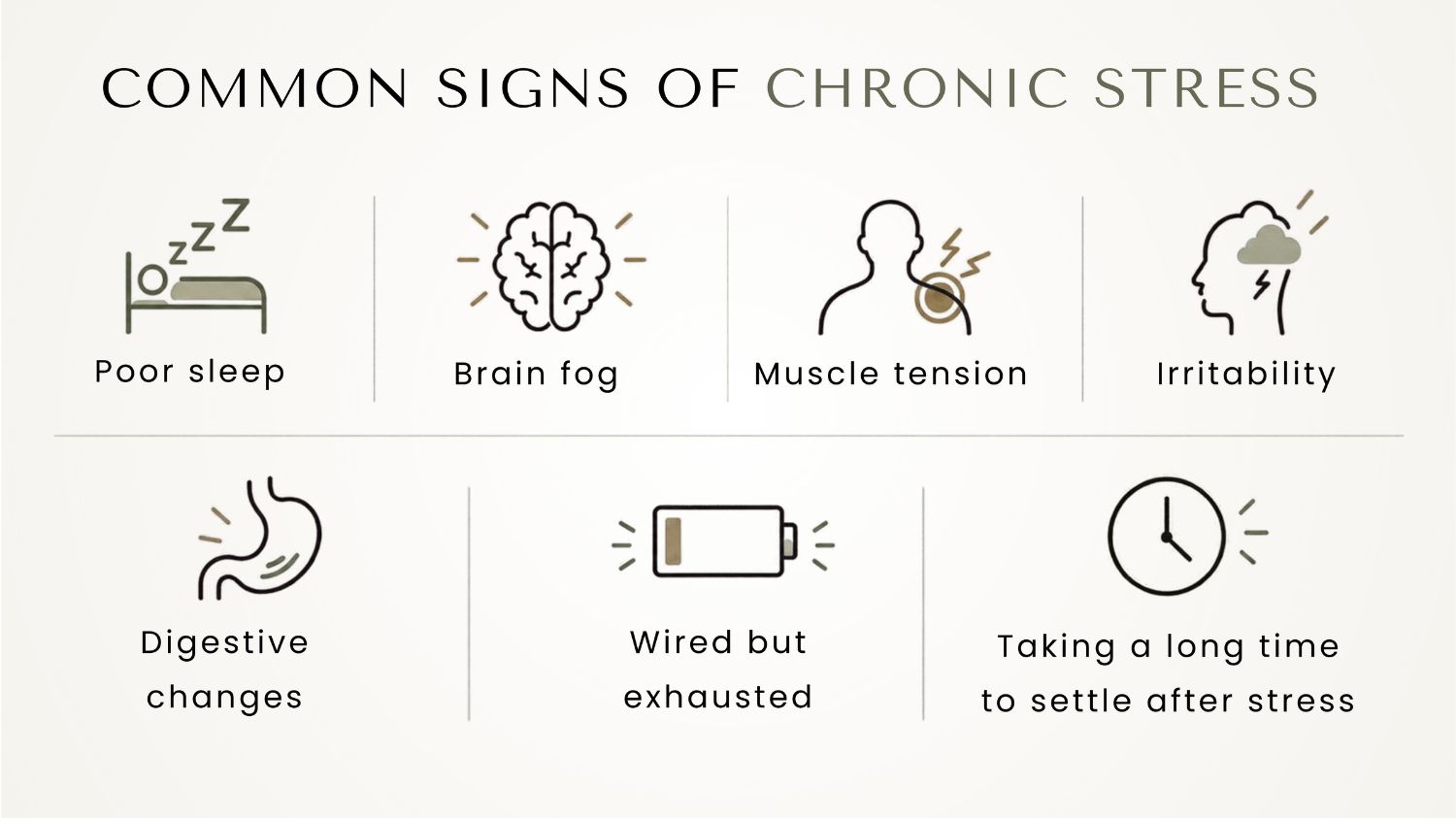
The slide we used on television captured the kinds of clues I want people to notice: poor sleep, brain fog, muscle tension, irritability, digestive changes, feeling wired but exhausted, and being slow to settle.
Those symptoms are common and nonspecific. One isolated symptom does not tell you that stress is the cause. What matters is the pattern.
I’ve written much more about recognizing these signals in Understanding Your Nervous System and How to Listen to Your Body.
A symptom is information. It is not a diagnosis. But when we pay attention to our body’s signals and track them, we can begin to see if stress does indeed exacerbate or cause our pain points.
The question I wish I’d answered better
Then I was asked:
At what point do you stop thinking, “I’m just tired” or “I’m just frustrated,” and realize that something bigger may be going on with your stress level?
I wish I’d answered her question by beginning with the most important and obvious thing to say:
New, persistent, worsening, or otherwise concerning symptoms deserve appropriate medical evaluation.
Start paying closer attention when symptoms become persistent or recurring, when they begin showing up in several areas of your body or life, or when they interfere with your sleep, concentration, relationships, mood, work, or ability to enjoy your life.
Reduce your exposure to things that trigger stress when you can, doom scrolling included, and keep putting in the reps with stress-regulation practices. But if they don’t move the needle on your pain points, seek appropriate medical care. Stress regulation will only amplify the treatment they offer you.
So what does the 60-second stress reset actually do?
This was the practice I demonstrated on air:
First, let your breathing become a little slower and a little deeper than usual.
Then bring your attention toward the area of the heart or chest.
And while continuing that comfortable heart-focused breathing, deliberately call up a regenerative feeling like gratitude, care, love, appreciation, compassion, awe.
Genuinely feel this feeling, don’t just think the word.
Try to sustain this for at least 60 seconds.
That’s it! It is exquisitely simple but there are beautiful reasons for why it’s so powerful. Let’s break it down:
Bigger breathing isn’t necessarily better
The instruction I used on television matters:
Take a breath that’s a little slower, and a little deeper than usual. Easy and comfortable.
The goal is not maximum breath.
It is a tolerably slower breath rate that your system can gradually learn.
“Take a deep breath” has become almost automatic advice when someone is stressed, and often it can actually induce stress.
There’s a reason to start gently with the breath. While an ideal breath rate is at least 4-5 seconds in and 4-5 seconds out, that feels very unfamiliar and uncomfortable for many.
This is because your nervous system is fundamentally protective of you. Part of its job is to detect uncertainty and the unfamiliar and protect you from it. Research on uncertainty shows that unfamiliar or unpredictable situations can heighten threat-related responses. In practice, I see the same thing with breathing: even a slower, ‘healthier’ breath rate can initially feel threatening simply because it is unfamiliar.
If you’ve spent years breathing shallowly, bracing your abdomen, clenching your jaw, or living in a heightened state of alert, suddenly asking your body to soften and breathe differently may not immediately feel relaxing.
It may feel strange.
Sometimes it can even feel threatening.
That’s why, in Coaxing the Nervous System Toward Healing and Easier Change and Why Diaphragmatic Breathing Matters, I show you how to begin with very small changes.
Why bring attention to the heart and what does a good feeling have to do with stress regulation?
There’s more happening here than simply giving your wandering mind somewhere to land.
When you deliberately bring attention to the heart or chest area, you shift attention inward, toward the body. That inward focus can support interoceptive awareness, our ability to notice and interpret signals coming from inside ourselves. Research on cardiac interoception shows that paying attention to heart-related sensations engages brain networks involved in body awareness, attention, emotion, and self-regulation.
In the HeartMath® practice, that heart focus becomes an anchor. With repetition, you’re not just practicing a breathing pattern. You’re repeatedly linking an internal bodily state with a felt experience of appreciation, care, calm, or connection.
Feeling is physiological too
The reset isn’t just about breathing more slowly and turning inward. The feeling matters too.
Slow, paced breathing can influence HRV (heart rate variability) and cardiovascular regulation. But genuine emotions such as gratitude, appreciation, care, and compassion also have a measurable impact on our physiology. HeartMath research has repeatedly paired breath, attention, and self-generated regenerative emotion, and a large 2025 analysis found that positive emotional states were associated with more coherent, stable heart-rhythm patterns. Independent studies using HeartMath-based techniques have also reported reductions in stress and changes in cardiovascular and HRV measures.
So the instruction isn’t simply to think of the word gratitude.
It is to actually feel grateful for something.
Or feel the love you have for a person, a pet, a place. You can conjure a memory of something that lets you genuinely experience a regenerative feeling like appreciation, care, compassion, love, awe, or ease.
I go deeper into this in Why I’ve Added HeartMath® as a Tool in Whole-System Healing, and Breathe Into Gratitude gives you a longer guided experience of combining breath with felt gratitude.
Does sixty seconds really make a difference?
Maybe.
But it helps to be clear about what sixty seconds is supposed to accomplish.
It is not going to resolve the reason your boss is furious, make your teenager suddenly cooperative, or eliminate a major financial problem.
The stressor may still be there after sixty seconds.
What can change is the state from which you meet it. And that’s why putting in little reps throughout the day is so important - not only are you building the “muscle memory” needed to return to a healthier baseline more quickly, you’re keeping yourself from getting too far from that healthier baseline in the first place.
One of the anchors asked whether it could be useful to pause after work, perhaps even sitting in the driveway before walking into a house full of children and responsibilities.
Absolutely.
I love transitions for nervous-system work.
Because whether we intend to or not, we often carry one environment into the next.
The meeting follows us into the elevator.
The argument comes with us into the car.
The workday walks through the front door.
So a transition practice is simply an opportunity to ask:
What am I carrying?
Do I still need it?
How am I breathing?
What state do I want to bring into what comes next?
Maybe that takes sixty seconds.
Maybe you need a walk around the block.
Maybe you need five quiet minutes before anyone asks you for anything.
The practice itself matters less than learning to notice that a transition is happening and being deliberate about how you want to show up in your next place.
Regulation doesn’t mean being calm all the time
One of the anchors also pointed out that someone watching might be thinking, I’m fine. I’m not chronically stressed.
Wonderful!
These nervous system resets are useful because stress is inevitable, and we need to know how to deal with it so stress never becomes a chronic problem.
Nervous-system regulation is sometimes sold as though the ultimate goal of health is to wander through life in a permanent state of serenity.
I don't think that’s realistic, and I don't think it’s desirable.
I want to feel excited when something exciting happens.
I want my body to mobilize when I need to perform.
I want grief to feel like grief and joy to feel like joy.
A healthy nervous system is one that can respond appropriately and has the flexibility to recover quickly.
What about taking time out for a longer practice?
On television I emphasized that nervous-system regulation doesn’t have to become another appointment on your calendar.
I stand by that.
Sixty seconds while your coffee brews is useful.
A reset at a red light is useful. Identify things you already do like folding laundry, taking a shower, standing in line at the grocery store, and make them cues to do a little reset rep.
But that doesn't mean longer practice isn't valuable. In fact I take at least 20 minutes every morning to set the energetic imprint I want to take through my day.
Sometimes taking twenty minutes to deliberately step away from stimulation, inhabit your body, breathe, and practice sustained attention can offer something a one-minute reset cannot.
I have several longer practices on the site if you want them.
Breathe Into Gratitude is a 20-minute practice combining breathwork and gratitude.
Guided Full-Body Relaxation is a body scan designed to help you become more embodied and settle before sleep.
Guided Loving-Kindness Meditation cultivates compassion and warmth, which can be particularly helpful on days when “just be grateful” feels impossible or inauthentic.
The short practices and the long practices are not competitors.
One builds regulation into everyday life.
The other gives you time to explore it more deeply.
Practicing what I teach
At the end of the interview, an anchor told me that my presence itself felt calming.
That was a kind thing to say, and it is further evidence that what I practice and teach works - not because I had somehow eliminated stress. I hadn’t. What I had done was meet an unfamiliar challenge with the right mindset and with years of putting in the reps.
I certainly learned things I'll do differently the next time I’m in front of a television camera.
But I also came away with renewed respect for something I've been teaching for years:
Regulation isn't the absence of stress. It’s the capacity to move through stress and find your way back to calm.
Sometimes stress is a warning that something needs attention.
Sometimes it's a signal that recovery is overdue.
And sometimes it simply means:
This matters.
Further Reading
Understanding Your Nervous System
Nervous System Toward Healing and Easier Change
Why Diaphragmatic Breathing Matters
Why I’ve Added HeartMath® as a Tool in Whole-System Healing
Breathe Into Gratitude: A Potent Relaxer and Mood Booster
Longevity Beyond Biomarkers: What Matters for Healthy Aging
Frequently Asked Questions
Is all stress bad?
No. The stress response is an adaptive system that helps us respond to challenge. Problems are more likely when activation becomes chronic, recovery is inadequate, or stress begins interfering with health and daily functioning.
Is taking a deeper breath always better for stress?
No. The goal is comfortable, efficient breathing, not the largest breath possible. Excessive ventilation can reduce carbon dioxide and cause unpleasant symptoms. For some people, even slowing or deepening the breath can initially feel unfamiliar, so beginning gently is important.
Why combine a positive feeling with breathing?
Breathing and emotional state both influence physiology. Slow breathing can change HRV and cardiovascular regulation, while research on gratitude, compassion, and positive affect shows measurable changes in heart rate, HRV, and brain-heart activity. HeartMath combines the two by pairing comfortable heart-focused breathing with the sincere experience of appreciation, care, or another regenerative feeling.
What if I can’t feel gratitude when I’m stressed?
Don’t force it. The purpose is not performative positivity. Try care, compassion, appreciation, connection, steadiness, or remembering a person, animal, place, or experience that genuinely helps you feel a little safer or more grounded.
How long do I need to practice nervous-system regulation?
Even brief practices can be useful in the moment. Repetition matters because regulation is a learned skill. Longer practices can also be valuable for meditation, body awareness, and deeper recovery. They serve different purposes.
Author